

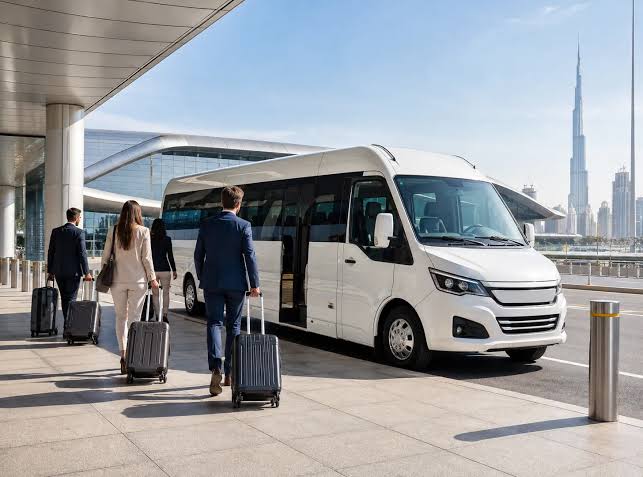

Businesses operating across multiple locations in Dubai often face transportation challenges that are different from those experienced by companies working from a single office.
A business may have its headquarters in a commercial district, a warehouse in an industrial area and another operational facility elsewhere in the city. Employees, supervisors and support teams may need to travel between these locations according to different schedules.
When these journeys are managed independently, transportation coordination can become unnecessarily complicated.
A structured approach helps businesses organize passenger movements, improve scheduling and reduce the administrative effort involved in recurring journeys.
Why Multiple Business Locations Create Transportation Challenges
The main difficulty is that different locations often have different operational requirements.
For example, a distribution company may need employees to travel from a central meeting point to a warehouse each morning, while supervisors visit other facilities during the day.
Similarly, businesses managing multiple offices may require staff transportation for meetings, training sessions and temporary assignments.
Common challenges include:
- Employees travelling to different facilities.
- Changing work schedules.
- Multiple daily pickup and drop-off requirements.
- Temporary transfers between business locations.
- Difficulty coordinating several independent vehicles.
- Unclear responsibility for transportation arrangements.
Without a defined transportation plan, managers may spend unnecessary time organizing individual journeys.
Map Business Locations Before Planning Transportation
The first step is identifying all locations involved in regular passenger movement.
Businesses should prepare a simple location list containing:
- Main office address.
- Warehouse or operational facility addresses.
- Common employee pickup areas.
- Locations requiring recurring staff visits.
- Temporary destinations used for meetings or assignments.
Once these locations are documented, operations managers can identify recurring travel patterns.
For example, employees who regularly travel between the same residential area and warehouse may be suitable for a scheduled transportation arrangement.
Meanwhile, supervisors visiting several locations may require a different transportation plan.
Establish Separate Transportation Requirements for Different Teams
Not every employee needs the same transportation arrangement.
Administrative employees, warehouse workers, technicians and management teams may follow different schedules.
Trying to accommodate everyone through one fixed route can create unnecessary detours and longer journeys.
A better approach is to divide transportation requirements according to actual operational needs.
Regular workforce movement: Employees travelling to the same facility according to fixed shifts.
Management travel: Supervisors and managers moving between offices and operational locations.
Temporary assignments: Teams travelling to another facility for specific projects.
Business events: Employees attending meetings, conferences or training sessions at external venues.
This classification helps identify where shared transportation is practical and where individual arrangements may be more appropriate.
Choosing Suitable Vehicle Capacity
The vehicle should match the passenger count and route structure.
A smaller team travelling between two locations may require a smaller vehicle category.
When a larger workforce needs to travel together, a 50 seater bus rental may be worth considering, provided the confirmed passenger numbers and journey requirements support that arrangement.
A group bus for rent in Dubai can also help businesses coordinate employees who share the same destination and working schedule.
However, companies should not select vehicles based solely on the total number of employees across all locations. The relevant figure is the number of passengers travelling together on each journey.
Build a Repeatable Transportation Schedule
Businesses with recurring transportation requirements benefit from having a documented schedule.
For each route, operations managers should establish:
- Passenger groups.
- Designated boarding points.
- Departure times.
- Destination addresses.
- Expected arrival windows.
- Return journey arrangements.
- A process for reporting changes.
A documented schedule helps employees understand their travel arrangements and makes it easier for managers to coordinate daily operations.
It also provides a reference point when passenger numbers or facility locations change.
Manage Temporary and Unexpected Transportation Requirements
Not every business journey can be planned weeks in advance.
Companies may occasionally need to move employees for emergency maintenance, temporary projects or unexpected operational requirements.
Instead of changing an existing recurring route without considering its impact, managers should identify whether the additional journey requires a separate arrangement.
This helps avoid disrupting employees who depend on the regular transportation schedule.
Businesses should also establish a clear approval and communication process for additional transportation requests.
Why Centralized Transportation Planning Matters
Centralized planning allows management to understand how employees move between different business locations.
It can reduce duplicated booking efforts and make transportation requirements easier to review.
For companies with recurring journeys, reviewing passenger numbers and route performance periodically can also identify opportunities to simplify pickup arrangements.
This becomes particularly useful when a business expands, opens another facility or changes its operational structure.
Finding Transportation Support for Business Operations
Businesses searching for bus rental in Dubai should communicate their full transportation requirements before selecting a provider.
This includes the number of passengers on each route, facility addresses, recurring schedules and any temporary transportation needs.
Gulf Bus Rental offers transportation solutions for different passenger requirements in Dubai. Companies managing multiple locations can explore its services when considering organized transportation for their teams.
Final Thoughts
Managing transportation across multiple business locations requires more than arranging occasional vehicle bookings.
Companies need a clear understanding of passenger movement, recurring schedules and the operational purpose of each journey.
By grouping similar routes, choosing appropriate vehicle capacity and maintaining centralized coordination, businesses can make employee transportation easier to manage as their operations grow.